
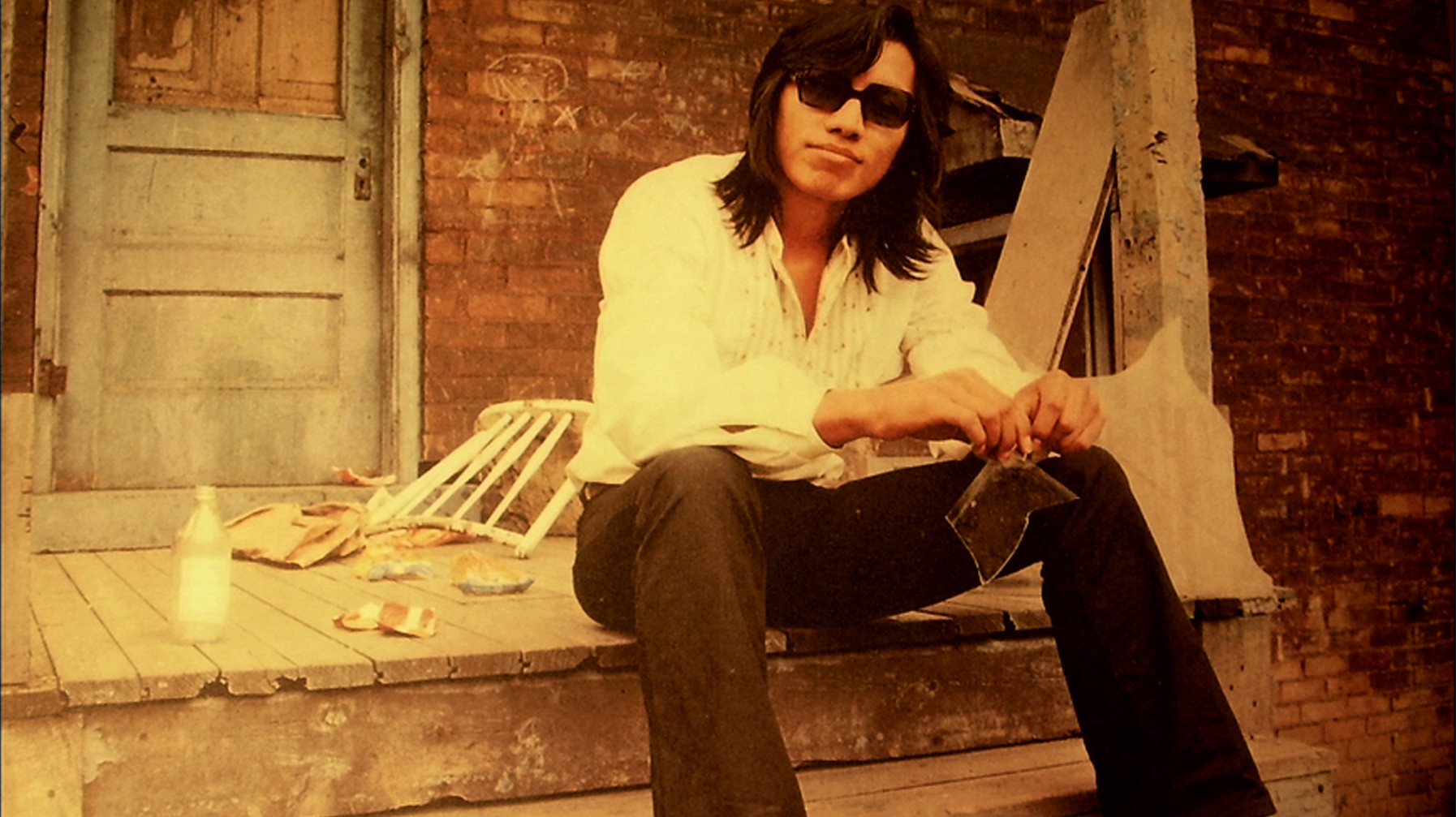
One muddy, corduroy coated morning, Seventeen September, the author sets off in search of Jesus, or at least the man he thought was Jesus-the guru, musician, poet or prophet more commonly known as Rodriguez, and creator of the long selling, 1972 cult album, Cold Fact.
With only fragments of information garnered mostly from the lyrics, he embarked on what would end up being a nine-month long detective-style inquiry on a subject reeking of conspiracy. An initial call to Polygram revealed nothing. A call to RPM, an earlier Rodriguez distributor, revealed less. Bizarrely, both carried no biography on one of their most successful artists (approximately 60 000 units sold in the last five years).
Next he tried the CD stores. All had heard of Rodriguez, and in fact, "I even sold a copy today", quipped a salesperson not old enough to have been around in '72.
Next he quizzed the people he knew-no dinner party
would be complete without a careful gruelling, eluding some fascinating
responses: Rodriguez died of a heroin overdose; Rodriguez brunt to death,
live on stage; Rodriguez went to jail for murdering his wife; and the most
common response: Rodriguez blew he head off while reciting his own epitaph:
Thanks for your time, and you can thank me for mine, and after that's
said, forget it!
Bang!
Climb up on my music, exclaimed Rodriguez, and my songs will set you free. When Cold Fact was released in S.A. in '72, no-one was free. Not the masses, then ruled by a minority. And not the minority then, and probably still, ruled by mass inhibition. The country had not yet received television, a two-year military service became mandatory and censorship ensured that not a nipple was in sight. It came as no surprise then that when Cold Fact hit the record racks, it became a hit, simply because it contained a phrase which would muddy the country's sexually chaste waters and serve as a mantra to the youth: I wonder, how many times you've had sex ...
In the early seventies, Hillbrow led the way as a fashionable, cosmopolitan haunt. Words like zol, dagga and buttons made their entry into everyday language and so did the need to smoke some. Then along came a man called Rodriguez who was able to mirror this need to be free, one who sang praises to his drug dealer in the song Sugarman, claiming that: you're the answer that makes my questions disappear. Unashamedly, he sang about Silver Magic Ships, Jumpers, Coke and Sweet Mary Jane in slang references to narcotics. (Both albums are riddled with drug references). And more than this, he sang of something new to S.A.: Disillusionment of crowded city life, dwindling job opportunities, slums and ghettos-a state he called the Inner City Blues, and a precursor in mindset to Punk which would soon follow.
A third call to Polygram finally produced a lead, the telephone and fax number of Michael Trayllor in Century City, California, lawyer to either the Rodriguez estate, or to Rodriguez himself (On that matter, the record company was extraordinarily vague). A fax went off requesting information. No reply was forthcoming. A day later the author actually called but received only a curt pre-recorded message. The number you have dialled has changed, please consult your local directory. In spite of licensing agreements and royalties, these numbers were all Polygram had.
Wilderness, a sleepy S.A. coastal village, the author embarks on a new course, the library of the nineties. With childlike optimism he types in a range of relevant words, from Rodriguez through to the desperate U.S. Births and Deaths. But to no avail. The sun is up but still the Net knows nothing-spewing out only the succinct: No matching words found.
Next, to ascertain the artists origin he scrupulously began to dissect the lyrics: In one song Rodriguez sings of being born near the world's tallest building, possibly a reference to New York; London, the liner notes state, was where Coming from Reality was made; And in Can't Get Away, he sings of being in Amsterdam.
Bank in Johannesburg, Q-magazine, New Musical Express and a host of other publications, including the world's leading music encyclopedias make no mention of Rodriguez. And not even a request to Shawn Phillips himself, who recorded 2nd contribution in London at about the time of Coming From Reality, reveals anything new. Notable, however, is the location of the Cold Fact recording; Detroit, the city which spawned not Folk Music, but rather the predominantly black sounds of Motown.
Months later in Cape Town the author meets Stephen "Sugar" Segerman, the person pivotal, with André Bakkes and Andy Harrod, in persuading Polygram to re-release the so-called lost album, Coming From Relity, retitled as After The Fact. Rumours have it that since no Master tapes could be found, a reasonably un-scratched vinyl version was located and used as the Master. On listening one can hear with digital precision, sheer proof of analogue decay-static, scratches and even a cat's paw. Nonetheless, the album is well received.
Richard Armstrong of Ace Records in London provides the next breakthrough. As a distributor of the Mike Theodore and Dennis Coffey catalogue (two names listed on Cold Fact), it seemed like a good place to ask. Several calls later and the author had in his possession like a secret code, Mike Theodore's number in Morriston, Michigan.
It started out with butterflies on a velvet afternoon, sound the words to It Started Out So Nice, demanding the question: Poet or prophet? With lyrics like, the night puts its laughter away, it would be hard to view Rodriguez as being anything less than a poet. His prose-like lyrics function well without music and are cutting and frank. In both albums barely a taboo of the day is left untouched-not even religion walks away unscathed. Yet, at times he becomes the 'prophet', seemingly prophesying on a morbid and dark future with lines like. In the third millennium, the crowded madness came, crooked shadows roamed through the night, the wizards overplayed their hand, and elsewhere, in spine-chilling fashion: all things in common suddenly grew strange, not unlike the Book of Revelations.
Probably the biggest question, if one reads between the lyrics, is why, not unlike Vincent van Gogh, he seemed obsessed with escape-an exit from what he saw as a socially ill society, seeming to rely on the temporary respite that narcotics offer. In It Started Out So Nice, he poses exactly such a question: How many times can you wake up in this comic book and still plant flowers, while in Can't Get Away, he sings of a force that torments him, that even in his hotel in Amsterdam, he finds inescapable. Not surprisingly, most who know Cold Fact, assume immediately that he must be dead.
"Jesus is alive!", said Mike Theodore early one Tuesday morning, "but he ain't the man you're looking for." My heart skipped a beat. "Jesus is only the brother. The one you're looking for is Sixto-the principle solo artist known as ... Rodriguez!"
Nine months had come down to this one moment.
"Wait", I said, "the one who's voice we hear on Cold Fact, the one you call Sixto, is he still alive?"
"Alive and kicking", said Mike, surprised at me even asking. But more surprising was that Theodore, and Rodriguez himself. I would later discover, had no idea that these albums sold as they did in S.A. let alone the cult status achieved-a strange phenomena since most royalty statements include the country of origin.
Mystified, I listened on:
Rodriguez, Motown session guitarist Dennis Coffley and producer Mike Theodore, all from Detroit, recorded Cold Fact in 1972 at Sussex Records, a label then owned by one Clarence Avant, a great believer in Rodriguez and today's head of a Motown.
"But then", I asked puzzled, "how come most of the songs are credited to Jesus and not Sixto ."
"That", he said after a long pause, "was a political move."
Hoping to prompt some explanation of 'political', I mentioned the 'drug, jail and fire' theories.
"Well", he refuted, "there's political ... and there's political."
"Will Jesus ... er Sixto speak to me?", I asked, hoping against hope.
"If Sixto wants to speak to you, then he will."
"Did you actually tell him I called?'
"Yeh, it's personal you know. We're trying to ascertain that status of each album ... in fact, we're in touch with Clarence Avant as we speak."
"Does Rodriguez own the rights to his songs?"
"Yes."
"Did he play Woodstock?"
"No, but he did tour Australia. Lots of money of his was being held there at one time."
"What is he doing today?"
"Same as before, playing music ..."
"But he won't talk to me."
A pregnant pause. "Well, let me just say this ... he's quite a recluse." With my heart pounding, I replaced the receiver.
After what seemed like a lifetime, I sat next to the telephone, hollow in a state of anti-climax. With many a cold fact at my disposal, I found myself teetering at the edge of the truth, yet nowhere close to it-to what actually drove someone like Rodriguez on such an intense search into the void of philosophy. And moreover, to what then prompted a 23-year long absence from recording-giving strange credence to the words he once sang:
So I set sail in a tear drop, and escaped beneath the door sill.
Home | Blog | Discography | Tours | Forum | Archives | Contact